
Structural Overview of the Platform Node
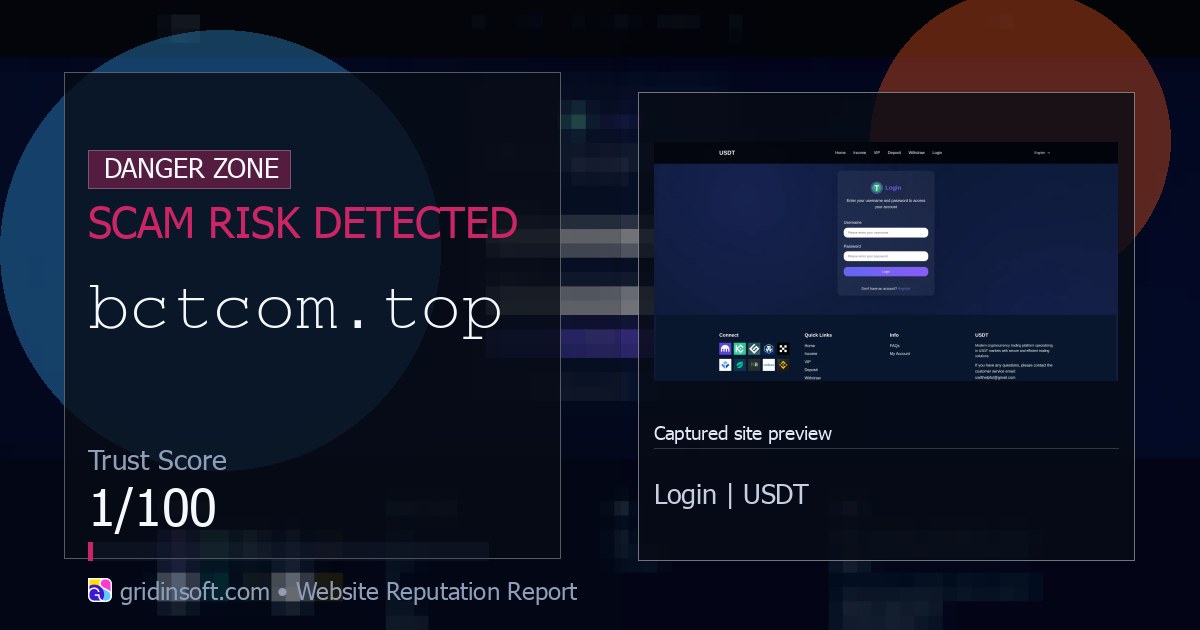
An independent infrastructure assessment managed by Charles James, Senior Forensic Analyst at EthicalAsset Solutions, has highlighted severe data discrepancies concerning the web interface located at bctcom.top. Within legitimate financial ecosystems, online trading applications maintain comprehensive regulatory transparency by publishing verified registration credentials with official cross border watchdogs. When an unverified interface establishes an isolated portal completely detached from these networks, users are left without regulatory protections or transparent transaction accounting.
A close inspection of the domain architecture confirms that bctcom.top operates using a low cost, top level domain (TLD) extension commonly favored for high-turnover deployments. Because these entities avoid open, organic indexing channels on major search engines, they rely entirely on closed social-engineering pathways to route individuals to their server.
Furthermore, the physical text string of the domain is clearly configured to mirror established, high-volume cryptocurrency hubs. This exact naming methodology relies on visual manipulation, betting that a participant will overlook the slight character variations and assume the interface is an authorized branch of a validated digital asset depository.
Mechanics of the Dashboard Simulation Phase
The primary interface experience inside bctcom.top uses carefully controlled communication loops to construct an illusion of legitimate high-yield trading. Most participants arrive at the domain via private introductions on encrypted messaging channels, specifically curated WhatsApp groups, Telegram channels, or specialized chat software. Inside these spaces, handlers presenting themselves as professional digital asset strategists provide structured market signals, instructing the participant to input these execution paths directly into the web application.
A forensic analysis of the platform’s backend script indicates that the environment functions as a closed visual database. The escalating return percentages, compounding historical yields, and daily trade settlement notices visible on the user dashboard are static numerical values generated by local software parameters.
While the user interface displays a rapidly growing balance, the actual cryptocurrency transmitted by the investor does not reside within an individual depository wallet tied to their profile. Instead, the incoming assets interact with an immediate distribution script that moves the tokens into unlinked pooled addresses almost immediately after block confirmation.
The Advance Fee Withdrawal Trap
The structural conflict within the bctcom.top ecosystem surfaces immediately when an individual requests an outbound distribution. The interface automatically denies the withdrawal query, and assigned account handlers step in via private messaging extensions to inform the user that their liquidity is temporarily locked.
To bypass this restriction, the handlers implement a classic advance-fee friction script, demanding immediate out-of-pocket payments to cover a variety of fabricated expenses. These commonly include:
-
A 15% manual capital gains tax or regional compliance clearance processing fee.
-
An external account synchronization deposit to link the recipient’s external wallet.
-
Cross-chain protocol fees or artificial intelligence processing overhead costs.
The forensic intelligence team at EthicalAsset Solutions notes that transferring additional capital into these destination addresses will not clear the dashboard block. Genuine financial institutions process standard transactional fees directly from an existing portfolio ledger balance; they never require an external, out-of-pocket transaction to authorize a distribution request. If your primary goal is to safely engage a certified Crypto Asset Recovery Service, you must immediately halt all asset delivery to these network endpoints.
Deconstructing Ledger Dispersal Routes
While the web pages of bctcom.top can be altered or taken offline instantly by the operators, the underlying records on the public distributed ledger remain completely permanent. Commencing a dedicated Blockchain Forensic Audit enables tracking specialists to look completely past the simulated numbers shown on the website dashboard.
By taking the unique transaction hashes from your initial deposit records, our team can follow those scattered digital asset fragments across the public ledger. Even when operators attempt to split or scatter tokens across different networks, public ledger entries remain unalterable, allowing specialists to trace the flow until it recombines within high-volume, centralized exchange accounts.
If your priority is to recover stolen funds, avoiding automated recovery tools promoted on social media channels is highly advisable. Reversing a validated blockchain transfer requires precise ledger tracking and structured compliance presentations. Securing your original transaction data hashes, deposit receipts, and wallet communication strings is the absolute foundation of a successful recovery process. For anyone focused on how to recover stolen funds, success depends entirely on protecting your original transaction data hashes and mapping out the ledger telemetry.
Leave a Reply