

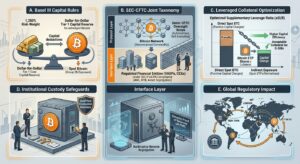
The structural integration of Bitcoin into balance-sheet banking relies entirely on capital adequacy standards set by the Basel Committee on Banking Supervision (BCBS). Regulators divide digital exposures into two core classifications: Group 1 (qualifying tokenized traditional assets and fully backed stablecoins) and Group 2 (unbacked crypto-assets, including spot Bitcoin).
Under the Group 2b framework, direct unhedged spot Bitcoin carries a 1,250% risk weight. Because commercial bank capital ratios mandate an 8% minimum Tier 1 capital holding against risk-weighted assets, multiplying a raw spot position by 1,250% requires a dollar-for-dollar Tier 1 capital offset ($100\text{m} \times 12.5 \times 0.08 = \$100\text{m}$).
+-------------------------------------------------------------------------------+
|                      BASEL III CAPITAL DEDUCTION WORKFLOW                      |
+-------------------------------------------------------------------------------+
|  Unhedged Spot BTC (Group 2b)                                                 |
|  └── Apply 1,250% Risk-Weight                                                 |
|      └── Imposes Dollar-for-Dollar Tier 1 Capital Deduction                   |
|                                                                               |
|  Hedged Spot ETP / Derivative Exposure                                        |
|  └── Apply Equity Standard Risk Model                                         |
|      └── Lower Capital Reserve Penalty (Optimizes Balance-Sheet Usage)        |
+-------------------------------------------------------------------------------+
This capitalization penalty makes direct balance-sheet holdings prohibitively expensive for Tier 1 institutions. Consequently, banks utilize indirect exposure channels. Holding spot Exchange-Traded Products (ETPs) or cash-settled derivatives allows financial entities to calculate risk reserves under traditional equity or commodity risk models rather than absorbing raw Group 2b deductions.
SEC-CFTC Joint Taxonomies: Protocol Separation and Interface Compliance
Complementing international capital rules, domestic joint interpretations from the SEC and CFTC establish a clear boundary between base-layer public blockchains and centralized financial intermediaries.
+-------------------------------------------------------------------------------+
|                   SEC-CFTC DUAL-LAYER REGULATORY BOUNDARY                     |
+-------------------------------------------------------------------------------+
|  PROTOCOL LAYER (Digital Commodity)                                           |
|  └── Autonomous Consensus | Open-Source | CFTC Oversight                     |
|                                                                               |
|  ==================== DYNAMIC COMPLIANCE BARRIER ===========================  |
|                                                                               |
|  INTERFACE LAYER (Regulated Financial Intermediaries)                         |
|  └── Custodians / Exchanges / VASPs | SEC, FinCEN & FATF Scope                |
|  └── Mandatory KYC/AML | zk-PoR Audits | Bankruptcy-Remote Segregation       |
+-------------------------------------------------------------------------------+
-
The Protocol Layer: The Bitcoin consensus network operates as an autonomous digital commodity under CFTC market oversight. Because the base layer functions without central managerial personnel, the protocol itself avoids securities registration burdens.
-
The Interface Layer: Regulated entities such as custodians, prime brokers, and exchanges absorb all localized compliance requirements. These entities must run real-time Anti-Money Laundering (AML) checks, maintain strict account segregation, and complete regulatory disclosures.
By insulating the base network layer from interface-level compliance demands, regulators preserve network neutrality while imposing strict risk management protocols on centralized financial access points.
Balance-Sheet Leverage and Qualified Custody Standards
Beyond capital charges, bank participation in crypto collateralized lending is governed by the Enhanced Supplementary Leverage Ratio (eSLR). Holding unhedged spot assets restricts a bank’s capacity to issue credit lines. However, collateralized ETP holdings allow prime desks to extend leverage against Bitcoin-backed instruments without breaching systemic leverage caps.
Simultaneously, non-bank intermediaries face rigorous operational mandates under updated safekeeping rules:
-
Cryptographic Liability Audits: Platforms must move beyond static asset proofs, implementing zero-knowledge Proof of Reserves (zk-PoR) to verify client liabilities dynamically without disclosing sensitive transaction histories.
-
Qualified Custodian Rules: Institutional managers must store underlying assets with licensed custodians providing bankruptcy-remote segregation, Hardware Security Module (HSM) multi-signature key architecture, and comprehensive crime insurance policies.
-
FATF Travel Rule Execution: Intermediaries must auto-transmit originator and beneficiary metadata for transfers crossing defined monetary thresholds, embedding compliance verification directly into transaction pipelines.
Leave a Reply