
In the early days of automated crypto trading, “trading bots” were extremely basic. They ran on simple, rigid rules: If Bitcoin drops 5%, buy $100 worth. If it goes up 5%, sell.
These old bots were fast, but they were essentially blind. They couldn’t read the news, they didn’t understand market panic, and they couldn’t adjust when gas fees spiked or a liquidity pool suddenly dried up.
That era is over. Today, autonomous AI agents are replacing old trading bots. These are advanced, self-learning software programs that manage multi-million-dollar portfolios and keep entire blockchain networks running around the clock all without needing a human to click a single button.
1. What Makes an AI Agent Different?
Unlike basic bots that just follow a script, an AI agent operates more like a digital financial manager. You don’t give it micro-commands; you give it intentions .
For example, instead of setting twenty complicated trading rules, a user can tell an AI agent:
“Keep my stablecoins earning at least 6% interest across crypto lending markets, but immediately pull everything out if market risk jumps.”
The agent takes that single goal, analyzes market data in real time, breaks down the required steps, and executes the necessary transactions automatically.
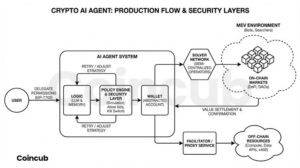
[ Your Goal / Intent ]
   └─ "Earn 6% yield, but keep risk low"
           │
           ▼
[ Off-Chain AI Brain ]
   └─ Reads news, checks gas fees, calculates risks
           │
           ▼
[ Safety & Rules Check ]
   └─ Enforces spending limits & safety locks
           │
           ▼
[ On-Chain Execution ]
   └─ Trades, moves funds, & optimizes yields
The Three Tech Upgrades Making This Work:
-
Account Abstraction: Special smart contracts (such asERC-4337) allow users to give AI agents permission to execute specific actions (like swapping tokens) within strict budget limits, without handing over complete control of their main crypto wallet.
-
Off-Chain Brains, On-Chain Action: Heavy AI models require too much processing power to run directly inside a blockchain. Instead, agents do their heavy mathematical thinking on private servers and then send lightweight, mathematically proven instructions directly to the blockchain.
-
Delegated Wallets: Agents use dedicated “sub-wallets” with daily spending limits, allowing them to pay their own transaction fees and rebalance portfolios 24/7 without asking for a human password every few minutes.
2. How AI Agents Manage Money
Human traders are slow, get emotional, and need to sleep. AI agents operate continuously across three core areas:
-
Automated Yield Hunting: If interest rates on a lending platform drop, the agent automatically shifts funds across different networks (like Arbitrum or Base) to find higher returns, calculating whether the bridging fees are worth the move.
-
Protection Against Front-Running: In crypto, malicious bots often “front-run” trades by jumping ahead in line to force users into worse prices. AI agents submit trades through private channels using tools likeFlashbots Protect to keep orders hidden until they are fully processed.
-
Instant Risk Hedging: If bad news breaks or market volatility spikes, an agent can instantly open short positions or buy downside protection in seconds protecting an investor’s main assets before a crash happens.
3. Managing Infrastructure Behind the Scenes
AI agents aren’t just trading tokens they are also handling background tasks that keep crypto protocols functioning.
| Operation | The Old Way (Human / Script) | The New Way (AI Agent) |
| DAO Treasuries | Slow governance votes taking 3–7 days to approve small moves | Dynamic yield deployment within pre-set community guidelines |
| Validator Nodes | Reactivate alerts that require an engineer to manually reboot servers | Predictive load balancing and auto-restarting glitchy hardware |
| Hack Prevention | Manual code audits that miss live, unexpected exploits | Continuous monitoring that pauses contracts the moment anomalous activity occurs |
| Transaction Fees | Fixed gas fee estimates that often get trades stuck | Real-time bidding for space on Layer-2 networks to minimize costs |
4. The Risks and Safety Guardrails
Giving software control over capital comes with clear dangers:
-
Manipulated Logic: Hackers can create weird, deliberate trading patterns to trick an AI’s sentiment algorithms into selling assets cheaply.
-
“Black Swan” Events: An AI model trained on historical data might panic or make wrong assumptions during a completely novel market event.
-
Hard Emergency Stops: To prevent catastrophe, developers build hardcoded rules directly into the underlying smart contracts. If an agent tries to move more than its allowed daily cap or acts erratically, automatic circuit breakers strip the AI of its permission instantly.
Summary
The arrival of AI agents transforms crypto from a manual, high-stress ecosystem into an automated one. By delegating complex calculations and round-the-clock monitoring to intelligent software, investors and developers can automate yield strategies and network security with far greater efficiency.
Leave a Reply